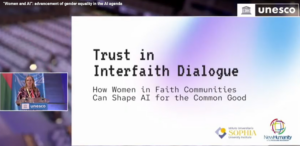
 Trust in Interfaith Dialogue: how women in faith communities can shape AI for the Common Good
In 1977, the United Nations officially designated March 8 as International Women’s Day, calling on all countries around the world to celebrate a day dedicated to women’s rights. On November 23, 2021, the UNESCO General Conference adopted Resolution 41 C/57 declaring January 25 as the International Day of Women in Multilateralism. Promoting equal rights, power, and opportunities for all, as well as a feminist future in which no one is left behind. At the heart of this vision is the empowerment of the next generation—young people, and in particular young women and girls—as catalysts for
sustainable change, and ensuring that this global priority becomes “an issue that concerns everyone,” as stated in paragraph 09200 of UNESCO document 43 C/5. UNESCO’s Women4Ethical AI initiative draws on the knowledge, contributions, and networks of leading experts in Artificial Intelligence (AI) to promote gender equality on the AI agenda. Ana Clara Giovani, from our NetOne network, participated in this important meeting. We are sharing her presentation.
Video in inglesse: https://www.youtube.com/watch?v=yWjlp75xYic
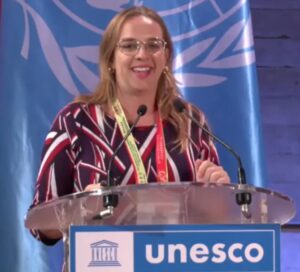
Trust in Interfaith Dialogue: How Women in Religious Communities Can Help Shape Artificial Intelligence for the Common Good
Distinguished representatives, colleagues, and friends,
It is a real pleasure to be here today to reflect with you on this very interesting intersection between technology and interfaith dialogue — and, in particular, to shine a light on the gender dimensions that shape this conversation. I don’t know how many of you have come across the Instagram account of a Buddhist monk1 who has gathered more than two million followers. The teachings are calm, reflective, spiritually grounded. And yet, the monk does not exist. He is entirely generated by artificial intelligence. This is an illustration of the level of technological mediation we’ve reached.
Technology is occupying spaces we consider sacred and human. And, for me, this raises a fundamental question about trust: In a world where millions of people follow the teachings of someone who does not exist, how do we cultivate trust — in human relationships more broadly, and more specifically within our religious communities and among our different faith traditions? We cannot pretend that the relationship between religion and technology is something new. It is historical and has been ongoing: from oral tradition to writing, from manuscripts to the printing press, from radio and television to the internet and social media, each new technology has sparked debates, fears, and processes of adaptation2. The issue here is not whether technology and religion will interact. They already do. There are numerous apps that assist believers in prayer and devotional practices, maybe you also use one of those. In Warsaw, a Catholic robot called SanTO interacts with the faithful, answering questions and offering spiritual guidance.
In Japan, at a Buddhist temple in Kyoto, a robot named Mindar delivers sermons to visitors, including monks3. At the same time, AI-based chat systems trained on sacred texts4 — either Buddhist, Islamic or Jewish — respond to theological questions, reproducing teachings and offering interpretations through conversational interfaces. This way, artificial intelligence is becoming a mediator of religious authority, interpretation, and we could maybe even say spiritual experience. But mediation is never neutral. It shapes what is transmitted, how this message can be interpreted, and who is recognized as a legitimate voice.
And here is where it’s important to add also the gender element. Historically, women have had limited space both in the development and governance of technology6 and in formal interfaith dialogue spaces. While women carry much of the daily work of religious communities — sustaining local networks, education, care, and grassroots engagement — religious leadership has, in most traditions, been predominantly male.
Interfaith dialogue, too, has traditionally been structured around encounters between official leaders, who have largely been men. Of course, this imbalance is not unique to technology or to religion. It reflects broader patriarchal social structures that have shaped access to authority, knowledge production, and decision-making power across societies. The widely known AI gender bias also intersects with religious and cultural bias. Training datasets are predominantly Western and heavily influenced by Christian references7.
As a result, AI systems often demonstrate lower accuracy when processing content related to non-Western religious traditions. Studies have shown8, for example, that terms associated with Islam are disproportionately classified with negative sentiment in text-analysis algorithms, while Christian texts appear far more frequently in training data than Buddhist, Hindu, or Indigenous traditions. In this sense, AI amplifies biases and systematizes the inequalities already embedded in our societies. When religious bias intersects with gender bias, women from minority faith communities risk becoming doubly invisible — both within technological systems and within formal interfaith representation. If artificial intelligence continues to increasingly mediate religious knowledge, authority, and interpretation, then the exclusion of women from shaping these systems is not simply a matter of representation. It becomes a critical ethical concern about whose voices define the spiritual and technological future we are building. Across different sectors, there is growing recognition that AI must be guided by principles that protect human dignity, inclusion, justice, and accountability. Initiatives such as the research work developed under Artificial Intelligence for Social Good9, UNESCO’s 2021 Recommendation on the Ethics of Artificial Intelligence10, and declarations by religious authorities11 — including Antiqua et Nova, Artificial Intelligence and Human Intelligence, published by the Catholic Church12 — all articulate, from their respective institutional and moral frameworks, the need to confront bias. They all converge around a shared concern: technology must serve humanity, not deepen existing inequalities, as Pope Francis stated in the Message for the World Day of Peace in 2024.
Building on this shared ethical horizon, interfaith dialogue and cooperation have a specific and timely role to play. I would like to suggest three concrete ways in which interfaith dialogue can contribute to AI for the Common Good:
- Advocate for diverse and representative datasets;This means systematic review, auditing, and updating of the large-scale databases already used by major AI systems. Gender, religious, and cultural diversity must be treated as fundamental ethical criteria in data governance, directly addressing the structural gender, religious, and cultural biases embedded in existing AI models.
This dimension resonates concretely with the Digital Oath14, an initiative of NetOne15 — the communication branch of the NGO New Humanity16 — with Sophia Univeristy, which proposes a public ethical commitment for all actors in the digital ecosystem, from developers to content creators. Inspired by the Hippocratic Oath, it explicitly includes the commitment to “be inclusive and fair in the creation and design of content.” When adopted by data scientists and engineers, this commitment directly implies responsibility for the biases that systems reproduce. Applied to datasets, this means that representativeness and diversity must be integrated from the very beginning of system design, rather than introduced as a corrective measure after deployment.
- Promoting digital literacy and technological education, especially by empowering women as educators and mediators;
Religious communities play a unique role in this field due to their global reach, their presence in rural and marginalized contexts, their already established relationships of trust with people, and the existence of their own educational structures. At a time when misinformation, fake news, and the manipulative use of AI particularly threaten vulnerable groups, this proximity and relational presence hold a relevant value.
This recommendation finds concrete expression in the project Senior’s App: The World at Your Fingertips, an initiative led by a researcher17 from NetOne — linked to the NGO New Humanity. Developed in Medellín, Colombia, precisely in the Grancolombiano Polytechnic University, the project involved 120 adults over the age of 50 in digital literacy workshops led by university students. The results were significant: participants developed skills to use mobile devices, access information, communicate with family members, and identify and question fake news. But the impact went beyond technical skills. Testimonials such as “I feel independent and more secure” or “I will have the possibility to communicate with my family” reveal that digital literacy is also an act of restoring dignity and social belonging.
The project further illustrates a principle that interfaith dialogue can embrace and expand: digital education is most effective when it takes place in contexts of trust, mediated by people who are close to the community, using accessible language and paying attention to real needs. This is precisely the type of environment that religious structures are able to provide.
Within this context, there’s a great opportunity for the development of female leadership as digital educators and mediators. In many religious communities around the world, women already play this structuring role — as catechists, teachers, trainers, and bridges between families and community life. Empowering religious women in digital literacy and in an ethical understanding of AI creates a powerful multiplier effect: women educating other women about technology, building trust and belonging in a field that remains predominantly male. This perspective is reflected in the Women4Ethical AI initiative, a platform promoted by UNESCO that works to ensure the equal participation of women in AI governance and development, based on the principle that truly ethical systems require women’s voices not only as users, but as designers, educators, and decision-makers.
- Preserving spaces of human trust that technology cannot
There is a fundamental distinction that must not be overlooked: the difference between reliability and trust18. We rely on a vending machine, on an elevator, on AI — and we expect them to function correctly. But trust, in its fullest sense, is something else entirely. Trust requires reciprocity. It is a bilateral act, rooted in our evolutionary history as social beings: two or more individuals who believe in each other’s loyalty, who can unite their strengths precisely because each one knows the other is capable of the same commitment in return. Because true trust demands this mutuality, what we build with AI systems, however sophisticated, remains structurally different from what we build with one another.
It is precisely here that religious communities offer something irreplaceable — not as an alternative to technology, but as a necessary counterweight to its limits. If trust in its fullest sense requires reciprocity, then the spaces where genuine reciprocity is still practiced and transmitted become structurally essential. Religious communities are among the few institutions that have always organized themselves around the cultivation of trust between persons, built through real presence, attentive listening, shared vulnerability and reciprocity.
1 @yangmunus, Instagram profile, accessed 21/02/2025, ttps://www.instagram.com/yangmunus/
2 Beth Singler, Religion and Artificial Intelligence: An Introduction (London: Routledge, 2023), 92, https://doi.org/10.4324/9781040121795
3 BBC News, “God and Robots: Will AI Transform Religion?” YouTube video, October 23, 2021, https://youtu.be/JE85PTDXARM
4 O Globo, “Fé na tecnologia: IA gera ‘guru’ seguido por milhões, ganha versão gospel, recria orixás e inventa religião,” O Globo (blog IAI), February 3, 2026, https://oglobo.globo.com/blogs/iai/noticia/2026/02/03/fe-na-tecnologia-ia-gera-guru-seguido-por-milho es-ganha-versao-gospel-recria-orixas-e-inventa-religiao.ghtml.
5 “For religions involved in digital platforms and social media, adapting to the medium may also affect their message, following the work of Marshall McLuhan and others,” in Beth Singler, Religion and Artificial Intelligence: An Introduction (London: Routledge, 2023), 92, https://doi.org/10.4324/9781040121795
6 “Women comprise only 22% of AI talent globally, with even lower representation at senior levels – occupying less than 14% of senior executive roles in AI,” in AI’s Missing Link: The Gender Gap in the Talent Pool (Brussels: Interface, October 10, 2024),
https://www.interface-eu.org/publications/ai-gender-gap
7 “Major global AI hubs, particularly in the United States, dominate the landscape of AI talent. However, even in these leading centers, female representation remains low, highlighting the pervasive nature of the gender gap,” in AI’s Missing Link: The Gender Gap in the Talent Pool (Brussels: Interface, October 10, 2024), https://www.interface-eu.org/publications/ai-gender-gap#conclusion
8 Singler, Religion and Artificial Intelligence, 96.
9Luciano Floridi, Josh Cowls, Thomas C. King, and Mariarosaria Taddeo, “How to Design AI for Social Good: Seven Essential Factors,” Science and Engineering Ethics 26, no. 3 (2020): 1771–1796, https://doi.org/10.1007/s11948-020-00213-5
10 Recommendation on the Ethics of Artificial Intelligence (Paris: UNESCO, adopted November 23, 2021), https://unesdoc.unesco.org/ark:/48223/pf0000381137
11 For viewpoints of different religions, see Rico C. Jacoba, “Exploring the Role of Artificial Intelligence in Interreligious Discourse,” RCJ 1, no. 1 (2023): pages 375-400, https://doi.org/10.62461/RCJ100323
12 Antiqua et Nova: Note on the Relationship Between Artificial Intelligence and Human Intelligence (Vatican City: Dicastery for the Doctrine of the Faith and Dicastery for Culture and Education, January 28, 2025),
https://press.vatican.va/content/salastampa/en/bollettino/pubblico/2025/01/28/250128b.html
13 Message of His Holiness Pope Francis for the 57th World Day of Peace: Artificial Intelligence and Peace, January 1, 2024 (Vatican City: The Holy See, 2023), https://www.vatican.va/content/francesco/en/messages/peace/documents/20231208-messaggio-57gio rnatamondiale-pace2024.html
14 Digital Oath Project, https://www.digital-oath.net/
15 Net‑One, https://www.net‑one.org/
16 New Humanity International, https://www.new-humanity.org/en/
17 Bustamante Marín, P., & Giraldo Jiménez, N. (2025). SENIOR’S APP: El mundo a un clic de distancia. Educomunicación hacia la inclusión y la paz. En I. Gatti (Comp.), Togetherness, media & communication for peace (p. 170). Editorial Cidade Nova
18 Andrea Galluzzi, “Fidarsi delle macchine?” Città Nuova, October 19, 2022, https://www.cittanuova.it/fidarsi-delle-macchine/