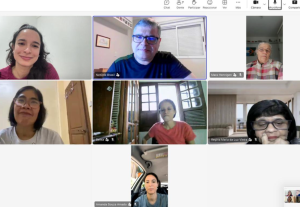
Below, we share the experience of Binky from the Philippines, originally presented at the most recent virtual meeting of the Communication and Media Community (photo), held on September 12. This presentation was followed by a fruitful discussion about the impacts of Artificial Intelligence on people’s lives, particularly on the work of communication professionals. Young people and adults from Brazil, Argentina, Italy, and the Philippines participated in this meeting.
“I’m Binky from the Philippines, and I work as a program manager for an NGO that was born from the charism of unity of the Focolare Movement. To achieve our goal of universal brotherhood, we help our student beneficiaries to continue their education, and we also provide services and holistic formation to their families and the communities that we serve.
As part of our program, we provide monthly formation to our student and parent beneficiaries with the goal of empowering them to improve their situations with dignity. We plan the topics of our formation sessions together with them and evaluate each session to understand the impact on their life.
One recurring topic for our monthly formation sessions is communication: it has become increasingly clear that our beneficiaries – particularly the younger ones – do not know how to communicate effectively with their families and peers. For the past 3 months, our formation topics have ranged from effective to non-verbal communication, and more recently, the ever-growing presence of AI in the post-COVID digital era. We felt that we had to focus our efforts on accompanying our students and families to navigate the use of AI and social media for ethical communication, resulting in a collaboration with New City Philippines to conduct a seminar entitled: AI for Truth and Dialogue: Empowering Young Voices for Authentic Communication – with a focus on how AI shapes modern Filipino culture, the impact of AI and social media usage on the youth and how communication can build bridges, as inspired by Pope Leo XIV’s encyclical Magnifica Humanitas. As a result, many of us understood how AI has become an extension of the environment we live in, shaping our culture and perspectives in positive and negative ways; the output during the workshops after the seminar shows the common message that AI should be treated as a tool to help us connect with others, but it is ultimately a tool that should not dictate how we should act and behave as human beings. Personally, I was inspired by the participation of our young students, who understood the value of different forms of communication – whether in words or actions, onscreen or face-to-face, and that even with the various means of technology made available by human beings for human beings, the critical point is that it is our being human that allows us to discern and decide how to use this technology, because as one of the young participants of that seminar shared as her impression: AI should never replace our humanity”.